A one-line change to a money helper should not be scary. In most codebases it is, because nobody can say with confidence what calls it, what calls those callers, and which tests would notice. You find out after the merge.
For the WeMakeDevs × FalkorDB Graph Hacks hackathon I built Aftershock to answer that question before the merge. It reads a repository, stores it as a property graph in FalkorDB, and answers "what breaks if I change this?" by walking the graph. Every answer comes with the path it took and how sure it is about each step.
The code is on GitHub, and the web UI is at aftershock-two.vercel.app.
Why grep is the wrong tool
Search finds where a name is written. Dependencies are about who calls whom. Those diverge quickly:
timesappears in comments, in other classes, and in a library you imported.- A method is reached through an import alias, a module attribute, or a subclass that overrides it.
- The test that would catch the bug lives three calls away, sometimes in a different repository.
Each of those is a hop in a graph. So I stopped treating the code as text.
The shape of the system
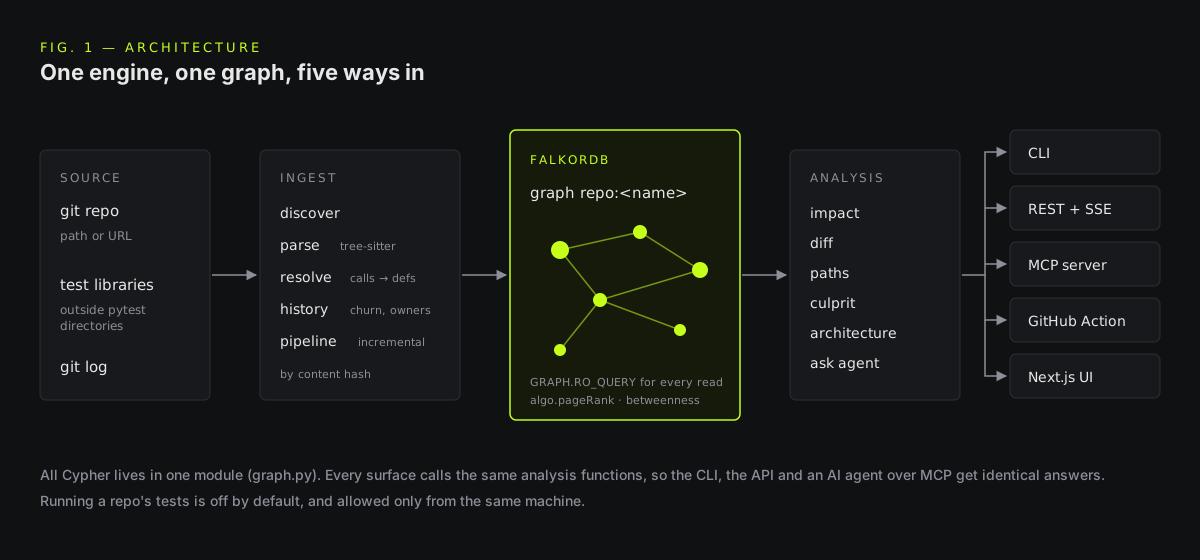
Indexing runs in four steps. Tree-sitter parses each file. A resolver then works out what every call actually points at: a local function, an imported one, a module attribute, or a best-guess inference. git log adds churn, co-change and ownership. The pipeline is incremental by content hash, so re-indexing after a small edit only rewrites the files that changed.
Everything after that is a query. The CLI, the REST API, an MCP server for AI coding agents, a GitHub Action, and the Next.js UI all call the same analysis functions, and all the Cypher lives in one module. An agent asking over MCP gets the same answer you see in the browser.
The graph
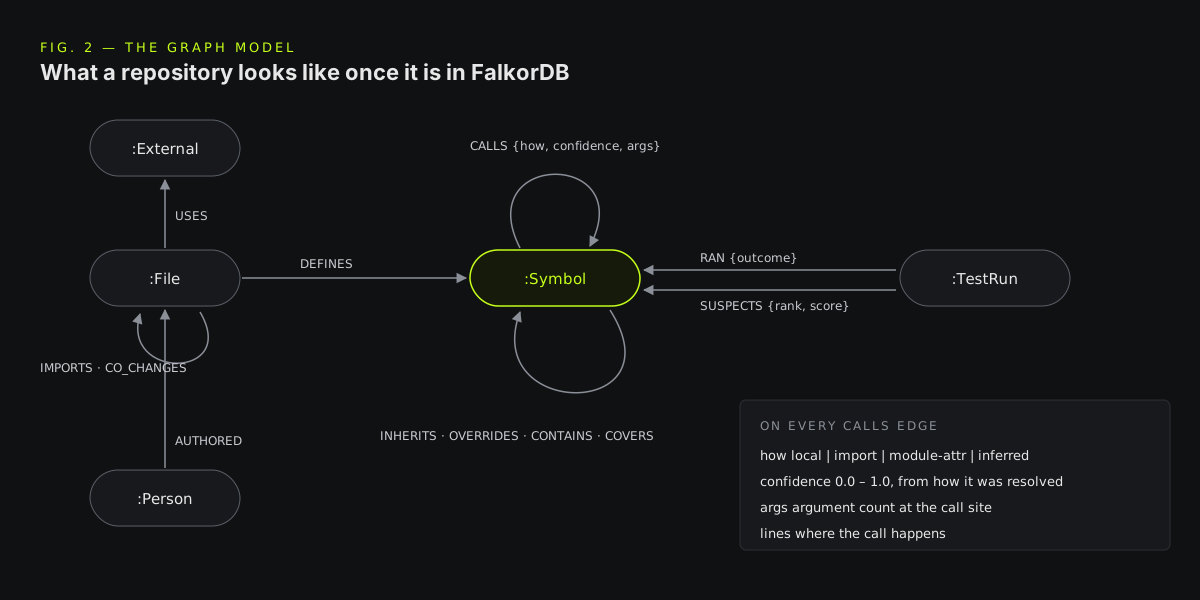
The decision that mattered most was what to store on the CALLS edge. Each one records how the call was resolved and a confidence for that method. An import-resolved call is more trustworthy than a name match, and the analysis should know the difference. Each edge also stores the argument count at the call site, which comes back later when a signature changes.
The rest of the model is there to answer specific questions:
CO_CHANGESbetween files catches coupling the code does not show: two files that always change together in git history.AUTHOREDanswers "who should review this?"COVERSrecords which tests actually executed a symbol, when per-test coverage has been collected.TestRunnodes withRANandSUSPECTSedges keep the history of test runs and what was blamed for each failure.
How impact is computed
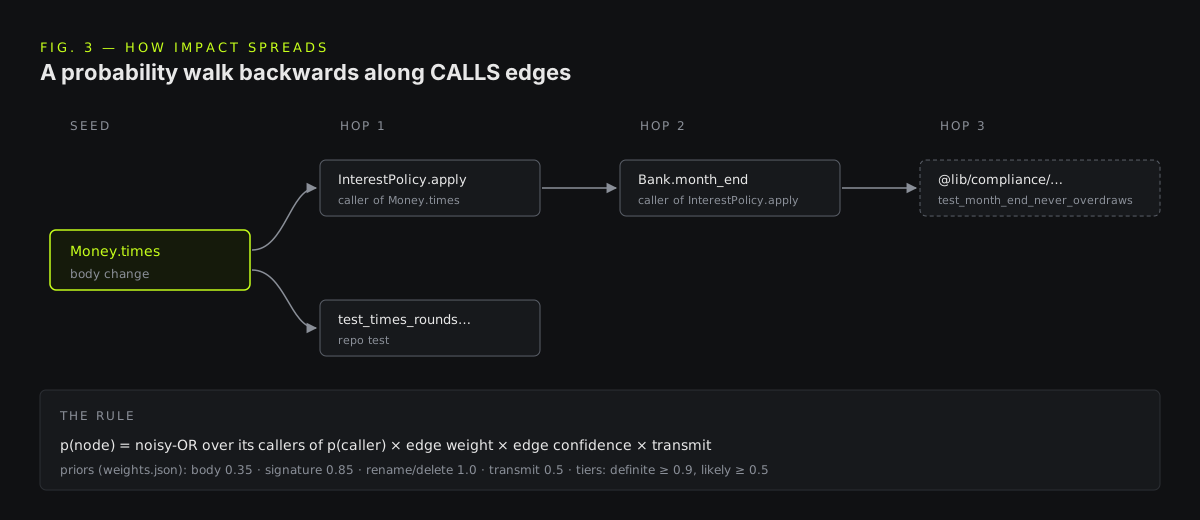
Impact is not a plain reachability query. Reachability says almost everything depends on almost everything, which is true and useless.
Instead it is a walk backwards along CALLS, INHERITS and OVERRIDES. Each node's break probability is a noisy-OR over its callers. Every hop multiplies in the edge type's weight, the edge's resolution confidence, and a transmit factor. The starting probability depends on the kind of change: deleting or renaming a function is certain to break callers, a signature change usually does, and a body change only sometimes does.
Signature changes get one extra check. Each call site's stored argument count is compared with the new signature, so a caller that still passes valid arguments is downgraded and one that cannot is flagged with the reason.
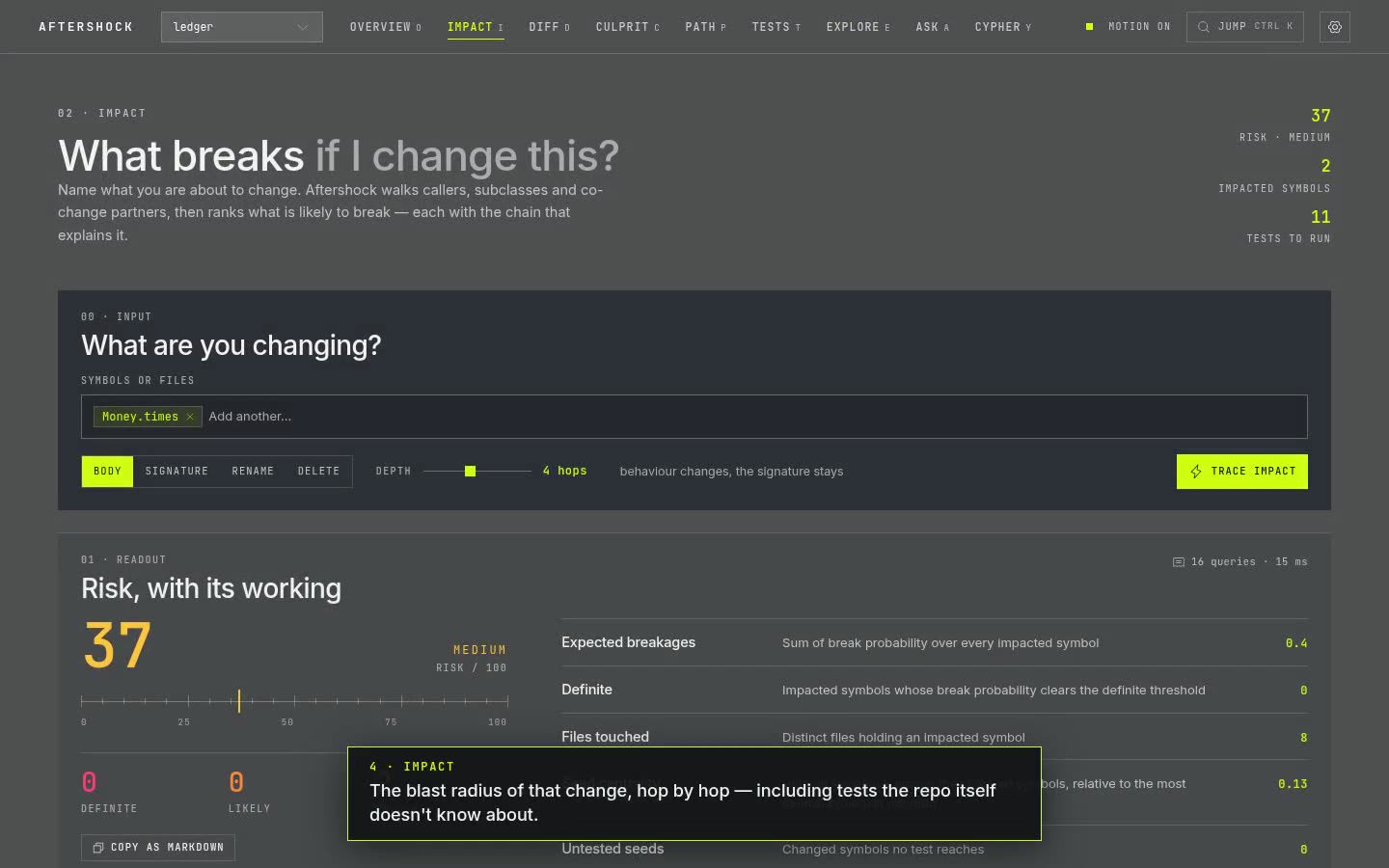
The weights live in a JSON file and are labelled as priors, not measurements. There is an eval command to tune them against a repository's own history. I would rather ship honest defaults than invented accuracy numbers.
What FalkorDB is doing
FalkorDB is not a storage layer here. It does the actual work:
- Bounded variable-length paths. Impact, test selection and path finding are openCypher with
*1..N. N is capped in config, so a hub function cannot produce a runaway query. - Built-in algorithms.
algo.pageRankoverCALLSranks central symbols,algo.betweennessfinds chokepoints, andalgo.labelPropagationoverIMPORTSgroups files into subsystems. Those three drive the overview page with no separate analytics job. - Full-text search. A
db.idx.fulltextindex over symbol names and docstrings lets you search by what a function does, not only by what it is called. - Read-only queries. Every read goes through
GRAPH.RO_QUERYwith a timeout. That one guarantee is what made two features safe: a raw Cypher console in the UI, and an LLM agent that writes its own Cypher. Neither can change the graph, whatever it sends.
Every response also carries receipts: the queries that ran and how long each took. When the tool says a change is risky, you can open the receipts and see why.
A worked example
The demo repository is a small ledger, plus a separate compliance test suite that the finance team keeps outside the repo. The change is one line: Money.times truncates instead of rounding.
1. Register the outside tests. The compliance suite is added as a test library. Its tests are indexed into the same graph under an @lib/compliance/ prefix, so they are visible to everything that follows.
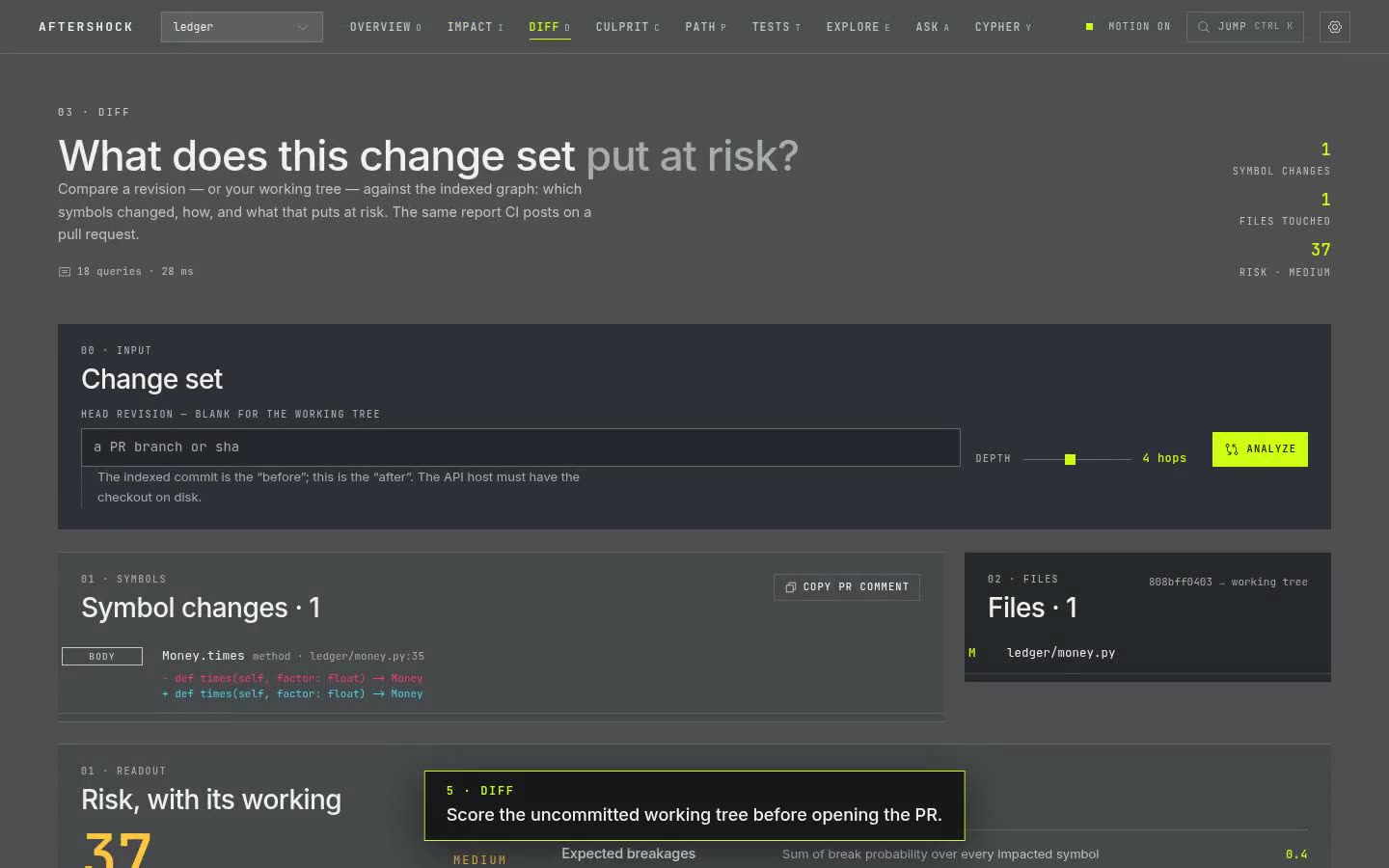
2. Score the diff. Diff reads the uncommitted working tree, maps the edit to the Money.times symbol by digest, and runs impact on it.
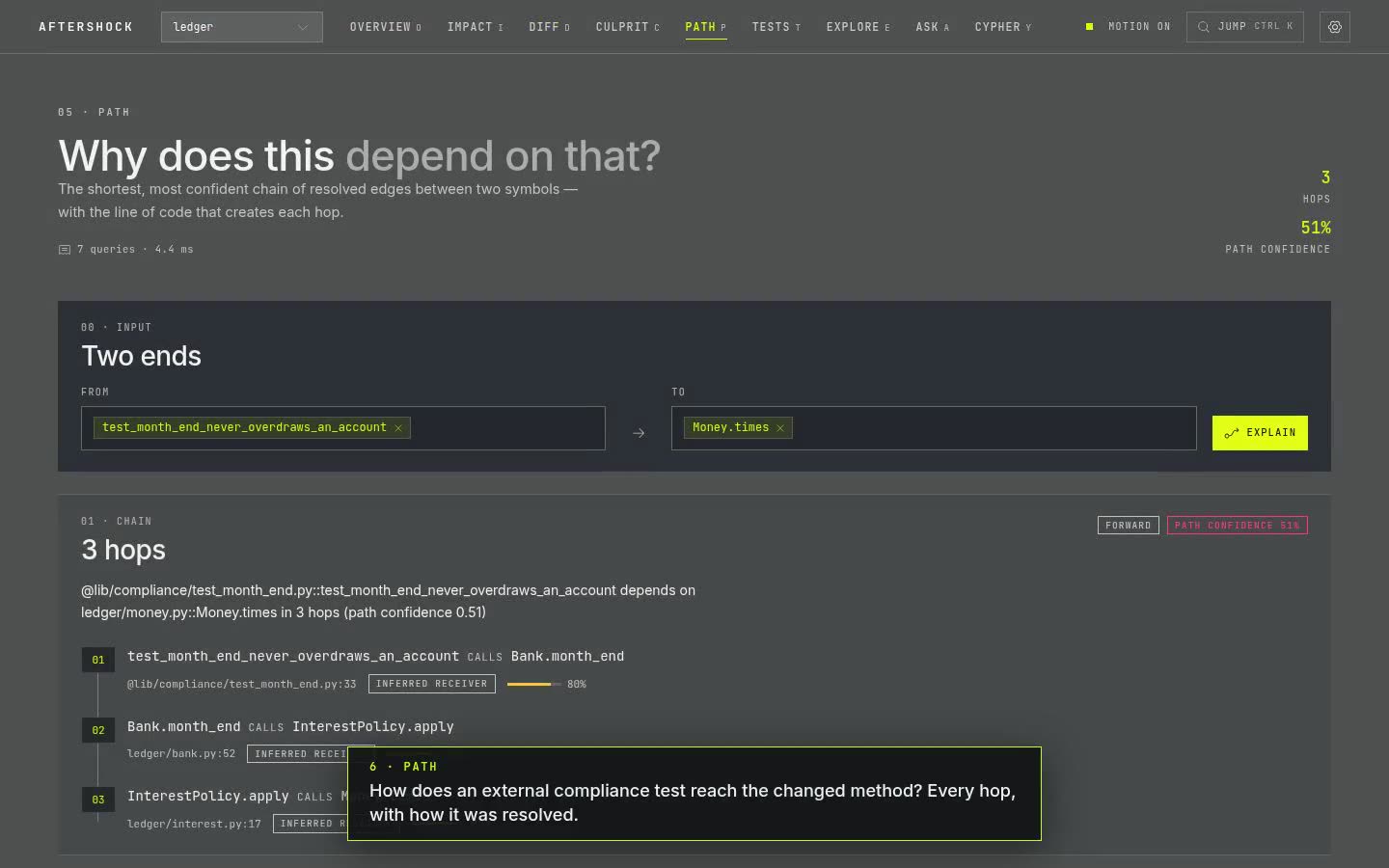
3. Ask why. The path view explains how a month-end compliance test reaches Money.times, one hop at a time, with the resolution method of each hop.
4. Run only what the change reaches. Tests are selected from the graph, repo tests and library tests together, and run. Some fail, as they should: the change is a real bug.
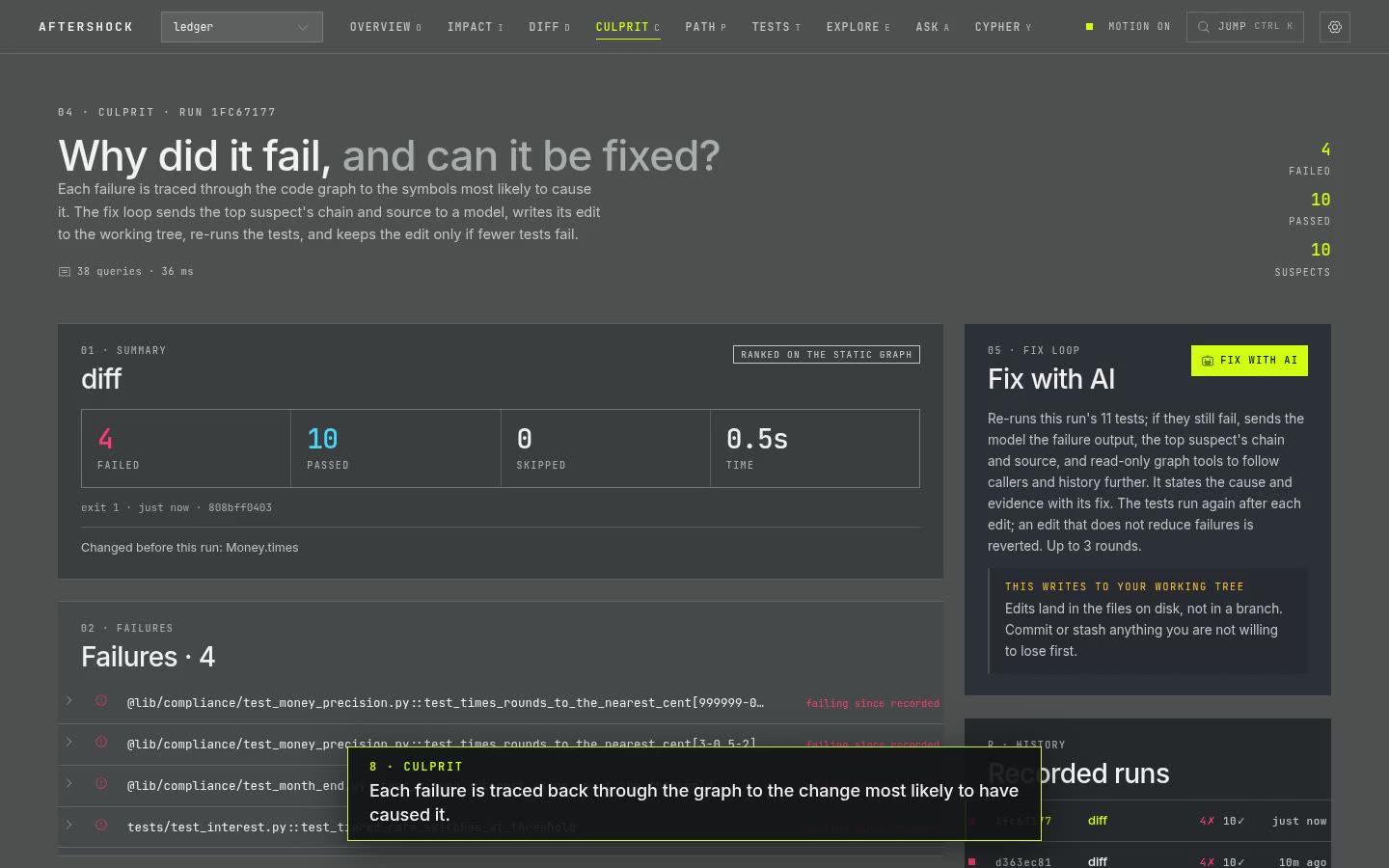
5. Find the culprit. Each failing test is traced back through the graph and the candidate causes are ranked with Ochiai scoring, a standard fault-localisation formula. Money.times comes out on top.
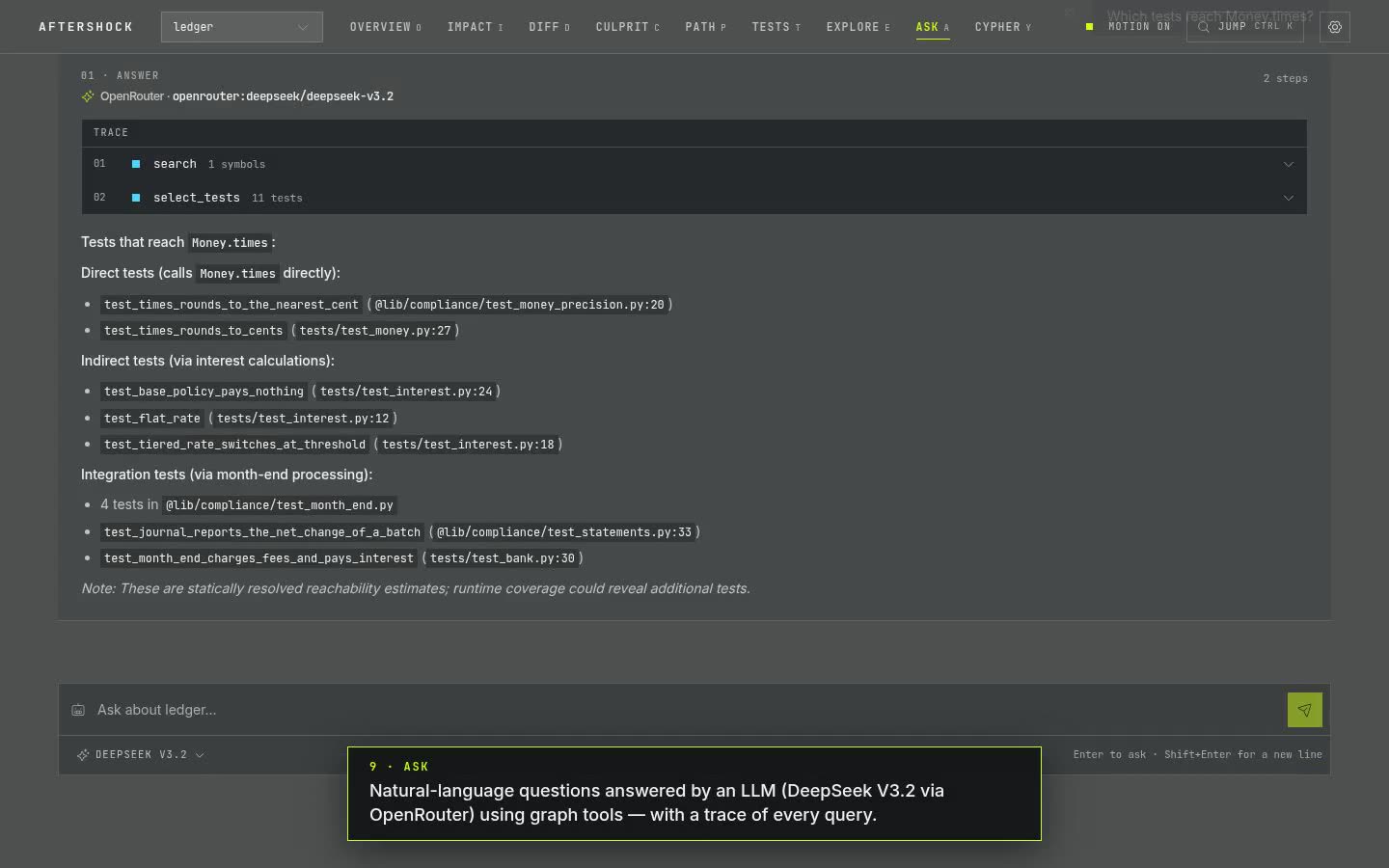
6. Ask in plain English. "Which tests reach Money.times?" goes to an LLM that can only use read-only graph tools. The answer comes with a trace of every tool call it made.
The two-minute video at the top of this post shows the full run.
Running other people's code safely
Running a repository's tests executes that repository's code. On a hosted demo that is remote code execution with extra steps. So it is off by default. The API only runs tests when the server is started with an explicit flag and the request comes from the same machine. The public demo never runs code, and its mutating routes need a server-side key that the browser never sees.
What I would do differently
- Measure the weights. The priors are reasonable, but the next step is running
evalacross real open-source history and publishing what comes out, good or bad. - More languages, deeper. Tree-sitter makes adding a parser cheap. Resolving calls well in each language is the expensive part.
- Cache the hot traversals. Most questions in a review session start from the same few changed symbols.
Notes on FalkorDB
What worked well: openCypher with variable-length paths made the core walks short and readable. Having PageRank, betweenness and community detection in the database removed a whole service. GRAPH.RO_QUERY is an underrated feature for anything that lets an LLM write queries.
What I would like to see: clearer guidance on query timeouts and TIMEOUT_MAX (I had to tune write timeouts to fit under the server limit), fuller parameter docs for the algo.* procedures, and a way to profile slow variable-length traversals.
If you maintain a codebase where a small change can cause a surprise, the repository has setup steps for the CLI, the API, the MCP server and the UI. Start FalkorDB in Docker, index a repo, and ask it what breaks.